



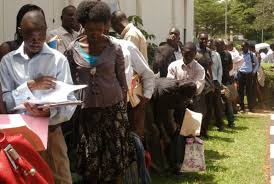
Youth unemployment continues to be one of the most pressing challenges facing Uganda, with millions of young people entering the labor market each year and struggling to find stable employment.
With more than 75 percent of the population under the age of 30, Uganda has one of the youngest populations in the world. While this demographic structure has often been described as a potential “demographic dividend,” economists warn that without sufficient job creation it could instead become a major economic and social challenge.
Across the country, graduates from universities and vocational institutions are increasingly finding it difficult to secure meaningful work.
A Growing Workforce, Limited Opportunities
Every year, thousands of students graduate from institutions such as Makerere University, Kyambogo University, and other tertiary institutions across Uganda.
However, the number of formal jobs created annually falls far short of the number of young people entering the job market. As a result, many graduates are forced to accept informal work, start small businesses with limited capital, or remain unemployed for extended periods.

For many young Ugandans, the transition from education to employment has become increasingly uncertain.
Economic analysts say that while Uganda’s economy has recorded periods of growth, the expansion has not translated into enough job opportunities for the rapidly growing population.
The Rise of the Informal Economy
Due to limited formal employment opportunities, a large proportion of young people have turned to the informal sector.
Street vending, boda boda transport services, small retail shops, and mobile money businesses have become common sources of income for many youth.
While these activities provide livelihoods for millions, they often come with challenges including unstable income, lack of legal protections, and limited access to credit.
Workers in the informal economy rarely benefit from social protections such as health insurance, pension schemes, or stable employment contracts.
Government Programs and Initiatives
Over the years, the government has launched several programs aimed at addressing youth unemployment.
Initiatives such as the Youth Livelihood Programme and the Parish Development Model were designed to provide financial support and economic opportunities for young entrepreneurs and rural communities.
These programs aim to provide funding, training, and support for youth-led projects in sectors such as agriculture, small-scale manufacturing, and services.
However, critics argue that implementation challenges, limited funding, and allegations of mismanagement have sometimes reduced the effectiveness of these initiatives.
Migration and the Search for Opportunities
The lack of employment opportunities has also driven many young Ugandans to seek work abroad.
Countries in the Middle East and parts of Asia have become popular destinations for migrant workers seeking employment in domestic work, construction, and other sectors.
While migration can provide income for families through remittances, it has also raised concerns about labor exploitation, unsafe working conditions, and the vulnerability of migrant workers.
The Role of Entrepreneurship
Many policymakers have increasingly promoted entrepreneurship as a solution to youth unemployment.
Start-ups in technology, agriculture, and creative industries have shown potential in creating new economic opportunities. Uganda’s growing tech community in Kampala has produced innovative companies in areas such as fintech, digital media, and online services.
However, young entrepreneurs often face challenges including limited access to financing, high interest rates, and regulatory barriers that make it difficult to grow small businesses.
Access to capital remains one of the biggest obstacles preventing youth-led enterprises from scaling into larger employers.
A National Development Priority
Experts say addressing youth unemployment will require long-term structural reforms.
These could include strengthening vocational training, improving access to financing for small businesses, investing in industrialization, and expanding sectors capable of creating large numbers of jobs.
Education systems may also need to adapt to better match the skills demanded by the labor market.
Without significant job creation, the growing youth population could place increasing pressure on the economy and social systems.
The Stakes for Uganda’s Future
For many young Ugandans, employment is not only about income—it is about dignity, independence, and the ability to contribute to national development.
As the country continues to grow, the challenge of creating opportunities for its young population will remain central to its economic future.
Whether Uganda can transform its youthful population into an engine of growth will depend largely on how effectively it addresses the question of jobs.
For now, millions of young people continue to wait for opportunities that match their ambitions and potential.